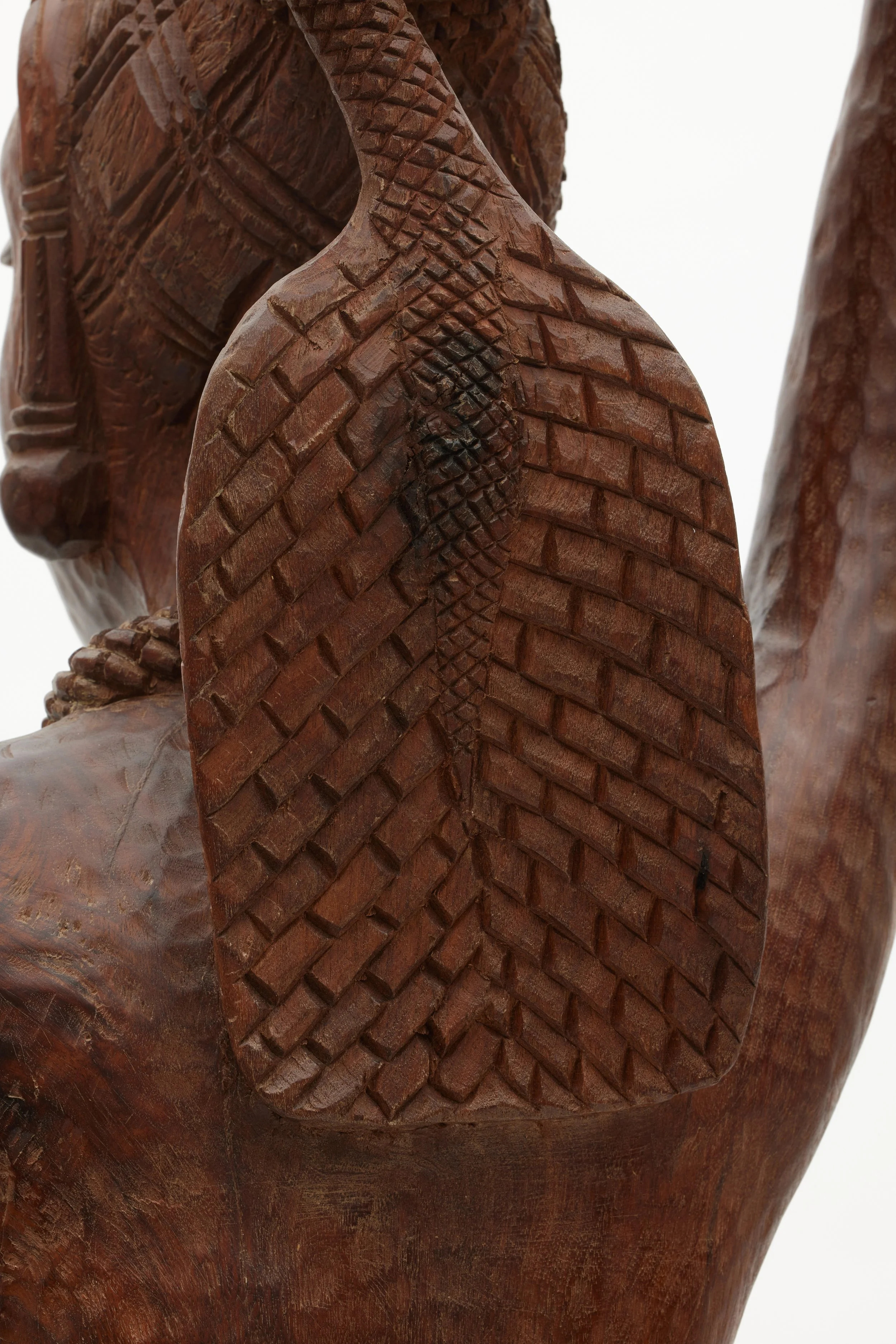
BIO.
Felix Eboigbe stands as one of the most compelling sculptors of the late twentieth-century African diaspora, an artist whose work bridges tradition and modernity while remaining deeply rooted in personal conviction. Born in Lagos, Nigeria, he was raised in Ewohimi, Nigeria, the eldest son of a Benin tribal chief, Eboigbe inherited not only a lineage of social responsibility but also a cultural environment in which art, ritual, and history were inseparable. In Benin culture—renowned for its centuries-old carving traditions—sculpture was never merely decorative; it was a vessel of memory, spirituality, and identity. Yet for Eboigbe, the path toward becoming an artist was neither expected nor easily accepted.
His family envisioned a more conventional future for their eldest son—one shaped by stability and prestige, such as medicine or engineering. But a moment of quiet revelation altered that course. As a student at Princess Day Catholic School, Eboigbe encountered photographs of marble and wood sculptures in the library. The images stirred something immediate and irreversible. He later reflected that, in that moment, he knew he wanted to “create art with his own hands.” This desire, simple yet profound, set him on a path that required both defiance and courage.
At sixteen, against his parents’ wishes, he left school and traveled to Lagos to apprentice under the renowned Nigerian sculptor Ben Aye. Traditional apprenticeships in African carving often lasted five years and demanded intense physical and mental discipline. Eboigbe completed his in just three—an early sign of both his natural ability and his relentless focus. This period shaped not only his technical skill but also his philosophy of making: art was not imposed on material but discovered within it.
Eboigbe’s understanding of sculpture remained deeply tied to this idea of revelation. He believed that wood itself possessed life and intention, once describing it as “alive, almost a piece of sculpture already.” Rather than sketching beforehand, he approached each block of walnut, cherry, or ebony as a collaborator. He would study the grain, feel its direction, and allow the form to emerge intuitively. Sometimes, as he put it, “there is an African girl dancing right out of an 8-foot piece of wood.” This dialogue between artist and material reflects longstanding African carving philosophies, where the sculptor reveals rather than invents.
By 1967, he had opened his own studio in Lagos, and his work quickly gained recognition. His sculptures—ranging from abstract forms to detailed depictions of warriors, women, and chiefs—carried both technical mastery and cultural depth. Many of his representational works drew directly from Benin oral history, especially stories passed down by his grandfather. In a culture where history was preserved through storytelling, Eboigbe saw sculpture as a vital means of preservation. Through carving, he transformed memory into form, ensuring that “cultural, religious, and tribal history” could endure across generations.
Recognition soon extended beyond Nigeria. His work attracted the attention of international institutions, and through the support of organizations such as the Ford Foundation and the United States Information Agency, he was invited to the United States. In 1970, he became an Artist-in-Residence at Indiana University, already regarded as one of Nigeria’s finest sculptors. This transition marked not a break from tradition but an expansion of it. Eboigbe arrived in America not as a student of Western art, but as a fully formed artist whose authority came from lived experience and inherited knowledge.
In the United States, he found both opportunity and a new role—as educator and cultural ambassador. His teaching reflected the same philosophy that guided his apprenticeship. “You have to let a student be free to create his own art, then guide him,” he believed. His classes became so popular that enrollment had to be limited, a testament to both his skill and his ability to inspire. Through demonstrations and lectures across the country, he introduced audiences to African artistic traditions not as distant artifacts, but as living, evolving practices.
Eboigbe eventually settled in Cincinnati, Ohio, where he served for over three decades as the first Distinguished Visiting Scholar of theVisual Arts in Residence at the University of Cincinnati. Even as his reputation grew—with exhibitions at institutions such as the Smithsonian and the United Nations, and collectors ranging from major corporations to figures like Kirk Douglas and Dave Brubeck—he maintained a deeply personal connection to his work. His sculptures retained a sense of stillness and dignity: elongated figures, often frontal and serene, embodying not individuals but ideals—ancestry, guardianship, and continuity.
Critics noted both the technical command and the emotional resonance of his work. Art critic Schubert Jones described his sculptures as possessing “a power and straight-forwardness which one equates with artists who know exactly what they want to do.” This clarity did not come from rigidity but from conviction. Even as contemporary art moved toward conceptual and multimedia forms, Eboigbe remained committed to carving—labor-intensive, tactile, and deeply rooted in tradition.
Over time, his work increasingly explored abstraction. These later pieces, often representing female forms or animals, were less about narrative and more about inner expression. He described them simply: each one represented his soul. This evolution did not abandon his heritage but expanded it, demonstrating how tradition can adapt without losing its essence.
Despite international recognition, Eboigbe’s life retained a deeply human arc. The early tension with his father—between expectation and vocation—eventually gave way to pride. His success did not erase his origins; it fulfilled them in an unexpected way. As the son of a chief, he had been born into responsibility. As an artist, he redefined that responsibility—not through governance, but through preservation of culture and expression of identity.
Felix Eboigbe’s legacy lies in this delicate balance: between past and present, discipline and intuition, personal voice and collective memory. His sculptures are not only objects of aesthetic beauty but also embodiments of lived experience—of a young boy inspired by photographs, of an apprentice shaped by tradition, of an artist who carried his culture across continents without losing its spirit.
In the end, his work reminds us that art is not simply made; it is discovered, negotiated, and lived. Through wood, form, and patience, Eboigbe transformed both material and self—leaving behind sculptures that are at once deeply rooted and universally resonant.
- David Smith, Eisele Gallery